Food stamps are monthly grocery benefits for low-income households — today officially called SNAP. Here is what the program is, who qualifies, how much you can get in FY2027, and how to apply.
Quick answer
What are food stamps? They are the Supplemental Nutrition Assistance Program (SNAP) — a federal program that gives low-income households money for groceries every month on an Electronic Benefit Transfer (EBT) card. The U.S. Department of Agriculture (USDA) funds it, and each state runs it locally.
What are food stamps, exactly?
What are food stamps in practical terms? They are a monthly grocery budget, paid by the federal government, for households whose income is too low to reliably cover the cost of food. The benefit is not cash and it is not a loan — it never has to be paid back, and it can only be spent on food for your household.
The program is the largest anti-hunger program in the United States. It is funded by the USDA through its Food and Nutrition Service (FNS), which sets the national rules: who is eligible, how benefits are calculated, and what can be bought. State and county agencies do the day-to-day work — taking applications, interviewing applicants, and issuing cards — which is why the program sometimes has a local name, such as CalFresh in California or 3SquaresVT in Vermont.
Why are they called food stamps if the name is SNAP?
Because for most of the program’s life, the benefits really were stamps. The first food stamp program ran from 1939 to 1943 and used orange and blue paper stamps. President Lyndon B. Johnson made the program permanent with the Food Stamp Act of 1964, and for decades recipients tore colored coupons out of a booklet at the register.
- 1939
First Food Stamp Program launches, using paper stamps bought at a discount and redeemed for surplus farm food.
- 1964
The Food Stamp Act makes the program permanent nationwide.
- 1977
Major reform removes the purchase requirement, so the poorest households no longer need cash up front to get stamps.
- 2004
Paper coupons are fully replaced by EBT cards in every state.
- 2008
The Food, Conservation, and Energy Act renames the program SNAP — the Supplemental Nutrition Assistance Program — to reduce stigma and reflect its nutrition focus.
The official name changed, but everyday language did not. Search data shows the same thing this article is built around: millions of people still ask “what are food stamps” every year, and caseworkers, stores, and state websites use both names side by side.
How food stamps work: the EBT card
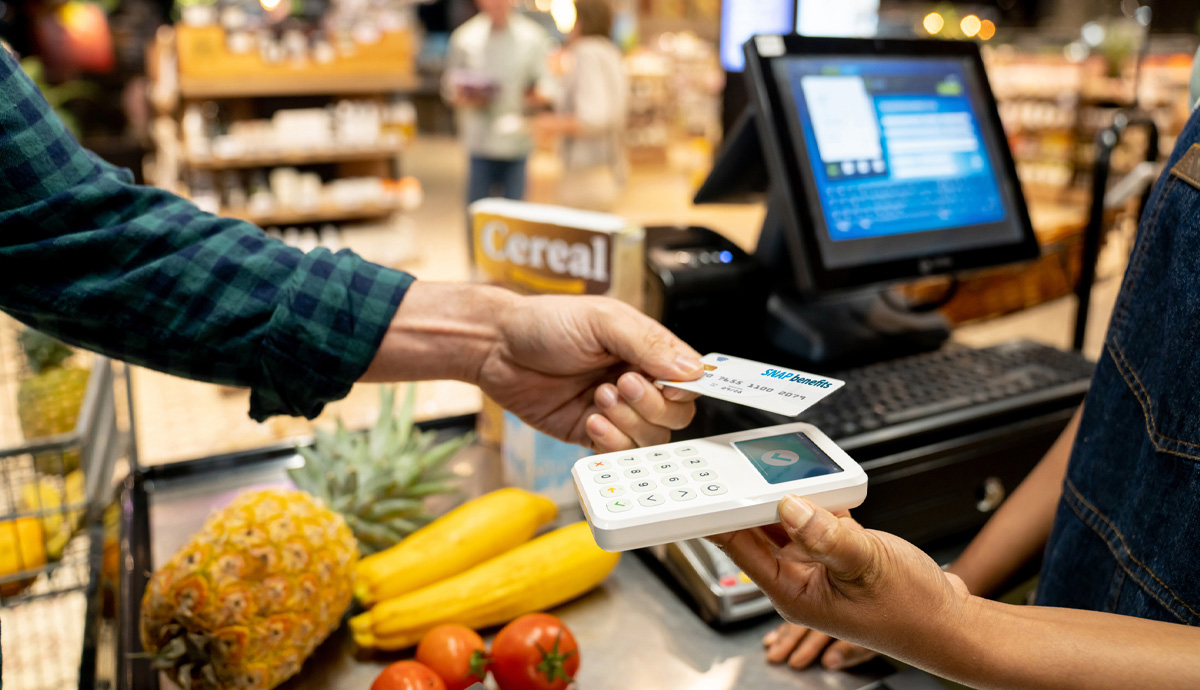
Once you are approved, your state issues you an Electronic Benefit Transfer (EBT) card. It looks and works like a debit card, protected by a PIN you choose. On the same day each month — the date depends on your state and case number — your benefit is loaded onto the card automatically.
- Where it works: USDA-authorized grocery stores, supermarkets, convenience stores, and many farmers markets — look for the “We Accept EBT / SNAP” sign or the Quest logo.
- At checkout: swipe or insert the EBT card, choose EBT, and enter your PIN. Eligible food is charged to the card; anything not eligible (or above your balance) must be paid another way.
- Online: SNAP can be used for online grocery orders at authorized retailers in most states, though delivery fees cannot be paid with benefits.
- Rollover: money you do not spend stays on the card for next month. Benefits can be removed after nine months of complete account inactivity, so use the card at least occasionally.
How much can you get? FY2027 amounts
Your benefit depends on two things: your household size and your net income. USDA’s formula assumes your household can spend 30% of its net income on food, so your benefit is the maximum allotment for your household size minus 30% of your net income. The less you earn, the closer you get to the maximum.
| Household size | Maximum benefit |
|---|---|
| 1 person | $306 |
| 2 people | $562 |
| 3 people | $808 |
| 4 people | $1,023 |
| 5 people | $1,217 |
| 6 people | $1,463 |
| 7 people | $1,616 |
| 8 people | $1,841 |
| Each additional person | + $225 |
One- and two-person households that qualify are guaranteed a minimum benefit of $25 a month in the 48 states and D.C. Source: USDA FNS FY2027 Cost-of-Living Adjustments.
Estimate your monthly benefit
Uses the FY2027 federal formula for the 48 states and D.C. This is an estimate only — your state agency makes the final decision.
Who qualifies for food stamps?
Eligibility is mainly about income. A SNAP “household” is everyone who lives together and buys and prepares food together — you do not have to be related. Most households must pass two income tests, and many states soften the first one.
| Household size | Gross limit | Net limit |
|---|---|---|
| 1 person | $1,729 | $1,330 |
| 2 people | $2,345 | $1,804 |
| 3 people | $2,960 | $2,277 |
| 4 people | $3,575 | $2,750 |
| 5 people | $4,191 | $3,224 |
| 6 people | $4,806 | $3,697 |
| 7 people | $5,421 | $4,170 |
| 8 people | $6,037 | $4,644 |
| Each additional person | + $616 | + $474 |
The other rules that matter
- Assets: federal limits are $3,000 in countable resources (cash, bank accounts), or $4,750 if someone in the household is 60 or older or disabled. Your home does not count, and most states waive the asset test entirely through broad-based categorical eligibility.
- Gross limit flexibility: in most states, categorical eligibility raises the gross income ceiling — often to 200% of poverty ($5,500 a month for a family of four). The net test still applies.
- Work rules: most adults aged 16–59 must register for work and accept suitable jobs. Able-bodied adults without dependents (ABAWDs), ages 18–64, must work or train at least 80 hours a month to keep benefits beyond three months. The upper age was raised from 54 to 64 by the federal budget law (H.R.1) enacted in July 2025, and states phased the change in through 2025–2026; the child-care exemption now covers children under 14.
- Deductions help you qualify: net income is what counts, and it is reduced by a standard deduction ($217 a month for households of 1–3 in FY2027), 20% of earned income, dependent care, high shelter costs, and medical expenses over $35 a month for elderly or disabled members.
- Immigration status: U.S. citizens qualify if they meet the income rules. Non-citizens have narrower eligibility — mainly lawful permanent residents (usually after five years), refugees, and a few other protected groups.
What can you buy with food stamps?
The rule of thumb: SNAP pays for food your household will eat at home. It does not pay for hot prepared meals, household goods, or anything with a Supplement Facts label instead of a Nutrition Facts label.
✓ You can buy
- Fruits and vegetables, fresh, frozen, or canned
- Meat, poultry, fish, and eggs
- Dairy products — milk, cheese, yogurt
- Breads, cereals, rice, and pasta
- Snack foods and non-alcoholic drinks
- Seeds and plants that grow food
- Baby formula and infant foods
✕ You cannot buy
- Alcohol and tobacco
- Hot foods and food eaten in the store
- Vitamins, medicines, and supplements
- Pet food
- Paper goods, soap, and cleaning supplies
- Cosmetics and hygiene items
- Live animals (except shellfish and fish removed from water)
One change to watch: since 2026, USDA has approved waivers in a growing list of states — including Florida, Texas, and Indiana — that also block SNAP purchases of items like soda, energy drinks, and candy. The exact list depends on your state, so check your state agency’s current rules before you shop.
How to apply, step by step
- Find your state agency
SNAP is applied for in the state where you live, usually through the state benefits website, a local SNAP office, or by phone. The USDA’s SNAP directory lists every state’s application route.
- Submit the application
You can often apply online in under an hour. You will need ID, Social Security numbers for household members applying, and income information. Submitting even a partial application (name, address, signature) starts the clock.
- Complete the interview
Most applicants have a short interview, usually by phone, within days of applying. A caseworker confirms your household, income, and expenses.
- Send verification documents
Pay stubs, rent receipts, utility bills, and ID copies are typical. The faster you send them, the faster the decision.
- Get your decision and EBT card
The agency must decide within 30 days. If your household has very low income and resources, expedited service can put benefits on a card within 7 days. If approved, the card arrives by mail with instructions to set your PIN.
Benefits are not one-and-done: you will recertify periodically (often every 6–12 months) and must report major income changes. If you are denied, you have the right to appeal and ask for a fair hearing.
Three common myths about food stamps
“Food stamps are only for people who don’t work”
Most SNAP households with children have earnings, and the program’s work rules require most able-bodied adults to work or look for work. The largest groups receiving benefits are children, elderly people, and people with disabilities — roughly two-thirds of all participants.
“People still get paper stamps”
Paper coupons disappeared in 2004. Benefits have been delivered on EBT cards for two decades — “food stamps” survives only as the nickname.
“You can buy anything at the grocery store”
The card automatically rejects ineligible items at checkout. Alcohol, hot food, pet food, vitamins, and household supplies cannot be charged to SNAP, and a growing number of states now restrict soda and candy as well.
Frequently asked questions
Are food stamps and SNAP the same thing?
Yes. “Food stamps” is the former name of the Supplemental Nutrition Assistance Program. Congress renamed it in 2008; the benefits, the EBT card, and the rules are one and the same program.
How much does a single person get in food stamps?
For FY2027 the maximum for one person in the 48 states and D.C. is $306 a month. Most people receive less, because the benefit equals the maximum minus 30% of net income — a single person with $800 of net income would receive about $66. Qualifying one- and two-person households get at least $25.
Can you buy hot food with food stamps?
Generally no — hot prepared food is excluded. The exception is the Restaurant Meals Program, which a few states offer to recipients who are elderly, disabled, or homeless, letting them buy prepared meals at participating restaurants.
Do unused food stamps roll over?
Yes. Unspent benefits stay on your EBT card month to month. They can be removed after nine months of no account activity, so use the card at least occasionally even if you are saving the balance.
How long does approval take?
Your state must process your application within 30 days. Households with extremely low income or resources qualify for expedited service and can receive benefits within 7 days of applying.
Can college students get food stamps?
Some can. A student enrolled at least half-time usually must also work 20 or more hours a week, receive federal work-study, care for a young child, or meet another exemption, on top of the normal income limits.
Sources
- USDA Food and Nutrition Service, SNAP Cost-of-Living Adjustment (COLA) information — FY2027 allotments, income standards, and deductions (effective October 1, 2026).
- USDA FNS, SNAP Fiscal Year 2027 Cost-of-Living Adjustments memorandum, August 21, 2026.
Figures on this page are the federal FY2027 standards for the 48 contiguous states and Washington, D.C. Alaska, Hawaii, Guam, and the U.S. Virgin Islands use higher amounts, and individual states may set higher gross income limits. Only your state SNAP agency can decide your eligibility and exact benefit.
